
Compare pricing models, features, and real fit for real estate developers evaluating Acumatica against Sage Intacct. Firms that switch to Elevate have cut month-end close time in half.
Used by Developers, Controllers & CFOs at 1000s of firms
New Book
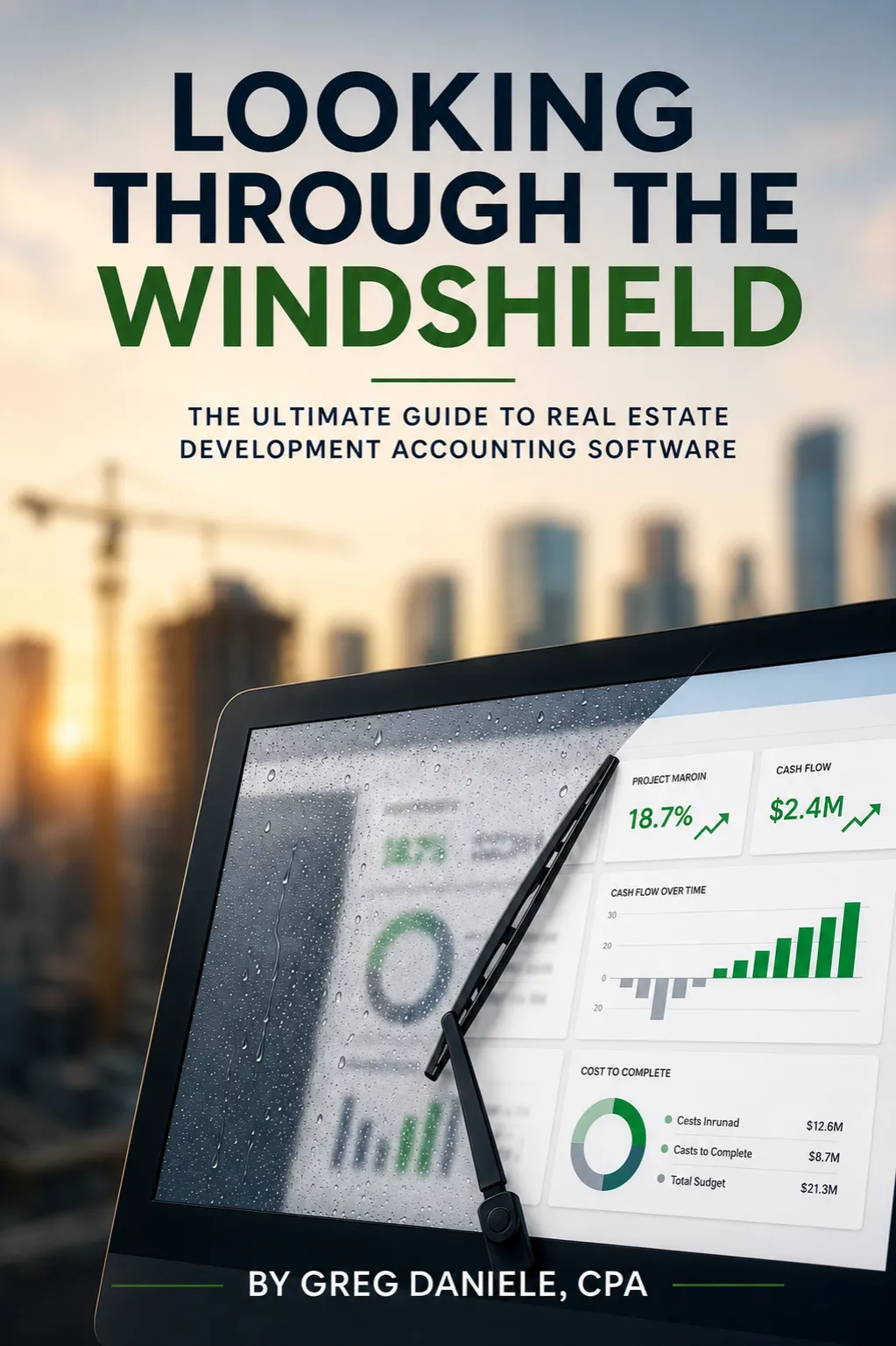
Looking Through the Windshield — the ultimate guide to real estate development accounting software. By Greg Daniele, CPA.

Acumatica gold certified partner
“We have visibility across our entire portfolio now. Draw requests that used to take days are down to almost an hour.”
CFO,
Real Estate Development Firm
“We used to hunt for answers. Now they’re just there. Real-time lot tracking and cost control mean we see issues coming before they become problems.”
VP of Finance,
Land Development Company
“We consolidated three systems into one and cut our month-end close time in half. Everything’s in one place: property management, CAM recovery and tenant improvements. It’s been a game changer for our operations.”
Controller,
Property Management Company
real estate firms
Acumatica-native
typical implementation
users — no per-seat fees
The three areas where the difference is genuinely not close.
If you self-perform construction, this is the decision that matters most. Development, construction job costing, and property management run natively on one Acumatica platform, sharing one dataset and one accounting system.
On Sage Intacct, construction functionality is a module add-on to core financials, and property management typically means a separate real estate module or a third-party marketplace connection, each with its own cost and its own data to keep in sync.
For a firm running all three functions, that’s the difference between one system and three systems wearing the same login screen.
Every new hire on Sage Intacct is a licensing conversation. Add a project manager, a field supervisor, or a back-office accountant, and the monthly bill goes up, whether or not that person touches the system every day or just needs occasional access to check a report.
Elevate’s Acumatica implementation includes unlimited users at no per-seat fee. A ten-person team and a forty-person team pay the same license cost for the same usage tier. That means field crews, project managers, and vendors can all get real system access, not a stripped-down guest login, without anyone weighing the cost of adding one more name.
Growth doesn’t mean a bigger software bill. It just means more people working from the same numbers.
Draw management and CRM are native to Elevate’s Acumatica implementation, not third-party marketplace add-ons layered on top of a core accounting system. Generate lender-ready draw packages directly from live job cost data, and track customer and vendor relationships in the same platform that runs your project financials, without a separate vendor, contract, or integration to maintain.
In Sage Intacct, both of these typically mean shopping the marketplace for a partner solution and then keeping that partner’s system synced with your core financials indefinitely. Every additional vendor in the stack is another point of failure, another renewal date, and another support line to call when something breaks. One platform means one place to look when something needs fixing.
Job costs, committed costs, and WIP positions get mapped and migrated from Sage Intacct so nothing is left behind as a reference-only archive.
Draw management, CRM, and other third-party tools you've built into your workflow get replaced with native Acumatica functionality, or connected fresh.
Cutover around a fiscal year-end or project milestone reduces the reconciliation work required during the transition.
Everything you need to know about Acumatica vs. Sage Intacct
It depends on your team size and how many modules you need. Sage Intacct’s per-user pricing can be competitive for a small, stable team. Acumatica’s unlimited-user model tends to be more cost-effective for a growing firm, since license cost doesn’t increase every time you add staff or give a field team member system access.
Sage Intacct tends to fit firms with a smaller, relatively fixed group of named users who want to build their stack from best-of-breed marketplace add-ons module by module, and who are comfortable with per-user cost scaling as those add-ons multiply.
Acumatica tends to fit firms planning to grow headcount or system access, since license cost doesn’t scale with every new login. It also fits developers who self-perform construction and want development, construction, and property management on one native platform rather than assembled from marketplace add-ons.
Yes. Sage Intacct’s construction and real estate modules include job costing, AIA billing, and lease and CAM management, added on top of its core financial platform. These are genuine, established capabilities, not an afterthought.
Only if you’re managing a large, primarily multifamily or institutional portfolio at enterprise scale. Both are enterprise-tier platforms built and priced for that buyer, with pricing and implementation complexity that reflect it. Most self-performing real estate developers evaluating Acumatica are a closer match to Sage Intacct’s market than to Yardi’s or MRI’s.
Typically one to three months, depending on the number of entities, active projects, and the volume of historical job cost data being migrated. Firms often time the switch around a fiscal year-end to minimize reconciliation work.
No, not if the migration is planned properly. Historical job costs, committed costs, and project data get migrated or reconciled at cutover as part of implementation, so project history carries forward rather than being left behind in the old system.
They typically need a native equivalent in Acumatica or a replacement integration. Draw management and CRM, for example, come native with Elevate’s implementation, so those specific add-ons usually get replaced rather than migrated.
Book a discovery call in under 60 seconds. We’ll show you what it looks like to run your development and portfolio operations through the windshield, not the rearview mirror.
We use cookies to improve your experience on our site. By using our site, you consent to cookies.
Manage your cookie preferences below:
Essential cookies enable basic functions and are necessary for the proper function of the website.
These cookies are needed for adding comments on this website.
Google reCAPTCHA helps protect websites from spam and abuse by verifying user interactions through challenges.
Google Tag Manager simplifies the management of marketing tags on your website without code changes.
Statistics cookies collect information anonymously. This information helps us understand how visitors use our website.
Google Analytics is a powerful tool that tracks and analyzes website traffic for informed marketing decisions.
Service URL: policies.google.com (opens in a new window)
You can find more information in our Cookie Policy and .

Imagine a single commercial property management software platform to develop and manage the end-to-end daily operations of all your real estate assets.