
Run Gantt and milestone scheduling, RFI and submittal tracking, and budget vs actual reporting on one platform connected to your accounting module, built on Acumatica. Developers running Elevate see issues before they become problems, not after they've cost time and money.
Used by Developers, Controllers & CFOs at 1000s of firms
New Book
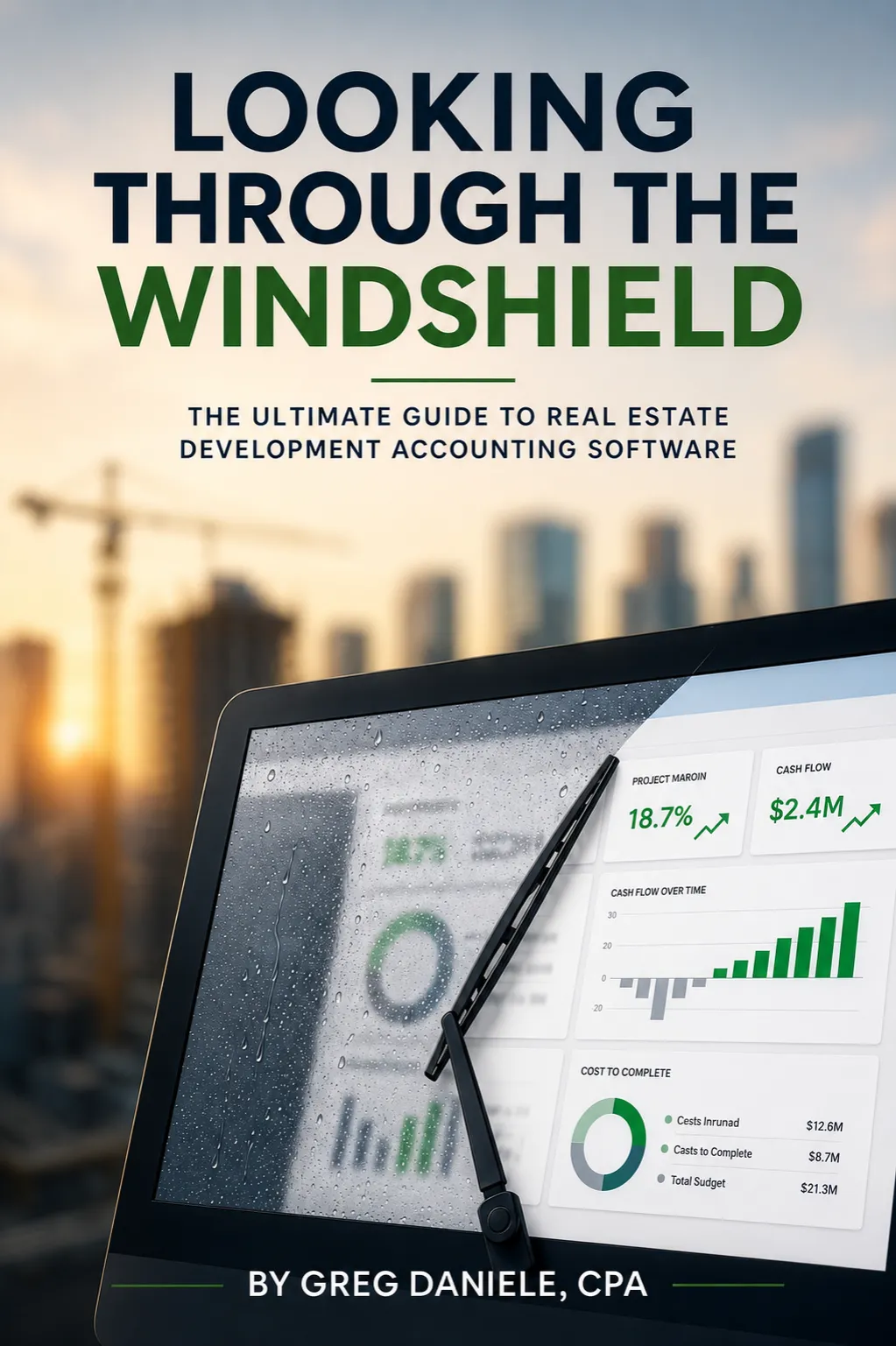
Looking Through the Windshield — the ultimate guide to real estate development accounting software. By Greg Daniele, CPA.

Acumatica gold certified partner
“We have visibility across our entire portfolio now. Draw requests that used to take days are down to almost an hour.”
CFO,
Real Estate Development Firm
“We used to hunt for answers. Now they’re just there. Real-time lot tracking and cost control mean we see issues coming before they become problems.”
VP of Finance,
Land Development Company
“We consolidated three systems into one and cut our month-end close time in half. Everything’s in one place: property management, CAM recovery and tenant improvements. It’s been a game changer for our operations.”
Controller,
Property Management Company
real estate firms
Acumatica-native
typical implementation
users — no per-seat fees
Everything you need to schedule, track, and deliver every project on time.
Stop managing your schedule in one tool and your budget in another, reconciled by hand once a week. Build project schedules with Gantt views and milestone tracking that tie directly to the cost codes and commitments driving your budget, so a slipped milestone shows up as a financial risk immediately, not three weeks later at a status meeting.
Dependencies between phases stay visible across the full project timeline, and drilling from a milestone down to the underlying budget line takes one click, not a separate export. Your project managers see the same schedule your controller sees, because it’s the same system.
Stop chasing RFI responses through email threads that go stale the moment a second person gets copied. On a generic project tool, an RFI lives in someone’s inbox, gets forwarded, and there’s no reliable record of who actually answered it or when. That gap is where schedule delays and disputed change orders both start.
Submittals and RFIs route through the platform with full status visibility, automatic reminders on outstanding items, and a complete history tied to the project and the specific cost code it affects. A stalled RFI shows up on a dashboard the moment it passes its response window, not three weeks later as a schedule delay nobody flagged in time to prevent it.
Every RFI and submittal keeps a permanent, searchable record: who asked, who answered, and when. That record is also what protects you if a delay or a cost dispute ever gets questioned by a lender or a general contractor.
Budget vs actual is the single most important report in development project management, and it’s only useful if it’s current. Every posted invoice, approved change order, and committed contract updates the budget instantly, because project management and project accounting run on the same data model instead of two systems reconciled by export.
Drill down from a cost code straight to the underlying invoice without leaving the project view. Automated over-budget alerts fire before a commitment is signed, not after the cost is already locked in.
For firms that force a generic scheduling tool to run development, this is usually the gap: the project manager tracks tasks, the controller tracks money, and nobody sees both at once. Here, they see the same numbers, in real time, from the same screen.
Manage projects owned by separate LLCs or partnership entities with automatic intercompany allocations.
Skip the separate company file per project. See consolidated reporting across every entity on demand.
Project final cost automatically from current budget, commitments, change orders, and PM forecasts.
Know where a project is headed at 20 percent complete, while there’s still time to act.
Route change order approvals digitally, linked directly to the affected cost code and budget.
Stop losing margin to change orders approved verbally and entered into the budget weeks later.
Centralize contracts, insurance certificates, lien waivers, and lender documents in one searchable repository.
Find any project document in seconds instead of days, with expiry tracking on what’s about to lapse.
Generate customizable dashboards by role, from single-project detail to portfolio-wide KPIs.
Give project managers and executives the same live data, with lender-ready and investor-ready templates built in
Generate lender-ready draw packages from live job cost data, with lender category mapping configured once.
Stop losing six to eight hours a month to manual draw assembly and the errors that cause lender rejections.
Schedule a discovery call with our real estate experts. Share your growth goals, current challenges, and operational pain points. Whether it's development cost tracking, contract management, loan draw preparation, or portfolio expansion, we'll map your needs to the right solutions.
Experience a personalized demo of the features that matter to you. Watch real-time budget control, automated draw packaging, and cost-at-completion forecasting in action. See exactly how you'll save time, eliminate errors, increase accuracy, and gain complete visibility.
Our implementation team handles all aspects of your go-live: data migration, system configuration, integrations, workflow setup, and hands-on training. Dedicated real estate professionals support you at every step. Start seeing benefits immediately: reduced risk, accurate reporting, and total control.
Everything you need to know about our real estate project management software
Real estate project management software is a platform for scheduling, tracking, and coordinating a development project, Gantt views, milestones, RFIs, submittals, and stakeholder reporting, connected to the financial data that project actually runs on. Generic project management tools handle tasks and timelines well but weren’t built to connect to budgets, commitments, or change orders, which means project managers end up tracking progress in one system while the controller tracks money in another.
Real estate project management software is scheduling and coordination-first: Gantt views, milestones, RFIs, and submittals, connected to budget data so both stay current. Construction management software goes deeper on field execution and job cost accounting for the build phase specifically. Accounting software for real estate developers goes deeper on job costing, AIA billing, and revenue recognition. All three run on the same underlying platform, so a project doesn’t need to be re-entered as it moves between planning, execution, and accounting.
Every milestone ties to the cost codes and commitments it affects, so a slipped milestone surfaces as a financial risk immediately instead of showing up separately in a budget report days or weeks later. Project managers and controllers work from the same schedule and the same numbers, rather than reconciling two views of the same project by hand.
RFIs and submittals route through the platform with status visibility and automatic reminders on anything outstanding, instead of living in email threads that go stale once more than one person is copied. A stalled RFI shows up as a flag on a dashboard, not as a schedule delay discovered after the fact.
Every posted invoice, approved change order, and committed contract updates the budget instantly, with drill-down from any cost code straight to the underlying invoice. Automated alerts fire before a commitment is signed and locks in an overrun, not after.
Project management and project accounting share the same data model, so a change order approved in the field updates the budget the moment it’s signed, and a milestone slip is visible as a financial risk without exporting anything to a spreadsheet. There’s no separate accounting system to reconcile against a separate project management tool.
Yes. Multi-entity project structures are handled natively, with automatic intercompany allocations and consolidated reporting on demand, rather than a separate company file maintained per project or partnership.
Implementation typically runs one to three months depending on the number of active projects and entities involved, considerably faster than the six-to-twelve-month timelines associated with legacy ERP rollouts. Teams often bring their current active projects onto the platform first, then expand as new ones break ground.
Book a discovery call in under 60 seconds. We’ll show you what it looks like to run your development and portfolio operations through the windshield, not the rearview mirror.
We use cookies to improve your experience on our site. By using our site, you consent to cookies.
Manage your cookie preferences below:
Essential cookies enable basic functions and are necessary for the proper function of the website.
These cookies are needed for adding comments on this website.
Google reCAPTCHA helps protect websites from spam and abuse by verifying user interactions through challenges.
Google Tag Manager simplifies the management of marketing tags on your website without code changes.
Statistics cookies collect information anonymously. This information helps us understand how visitors use our website.
Google Analytics is a powerful tool that tracks and analyzes website traffic for informed marketing decisions.
Service URL: policies.google.com (opens in a new window)
You can find more information in our Cookie Policy and .

Imagine a single commercial property management software platform to develop and manage the end-to-end daily operations of all your real estate assets.