
Run job costing by project and phase, AIA billing, WIP reporting, and percentage-of-completion revenue recognition on one accounting platform built on Acumatica. Firms that consolidate onto Elevate have cut month-end close time in half.
Used by Developers, Controllers & CFOs at 1000s of firms
New Book
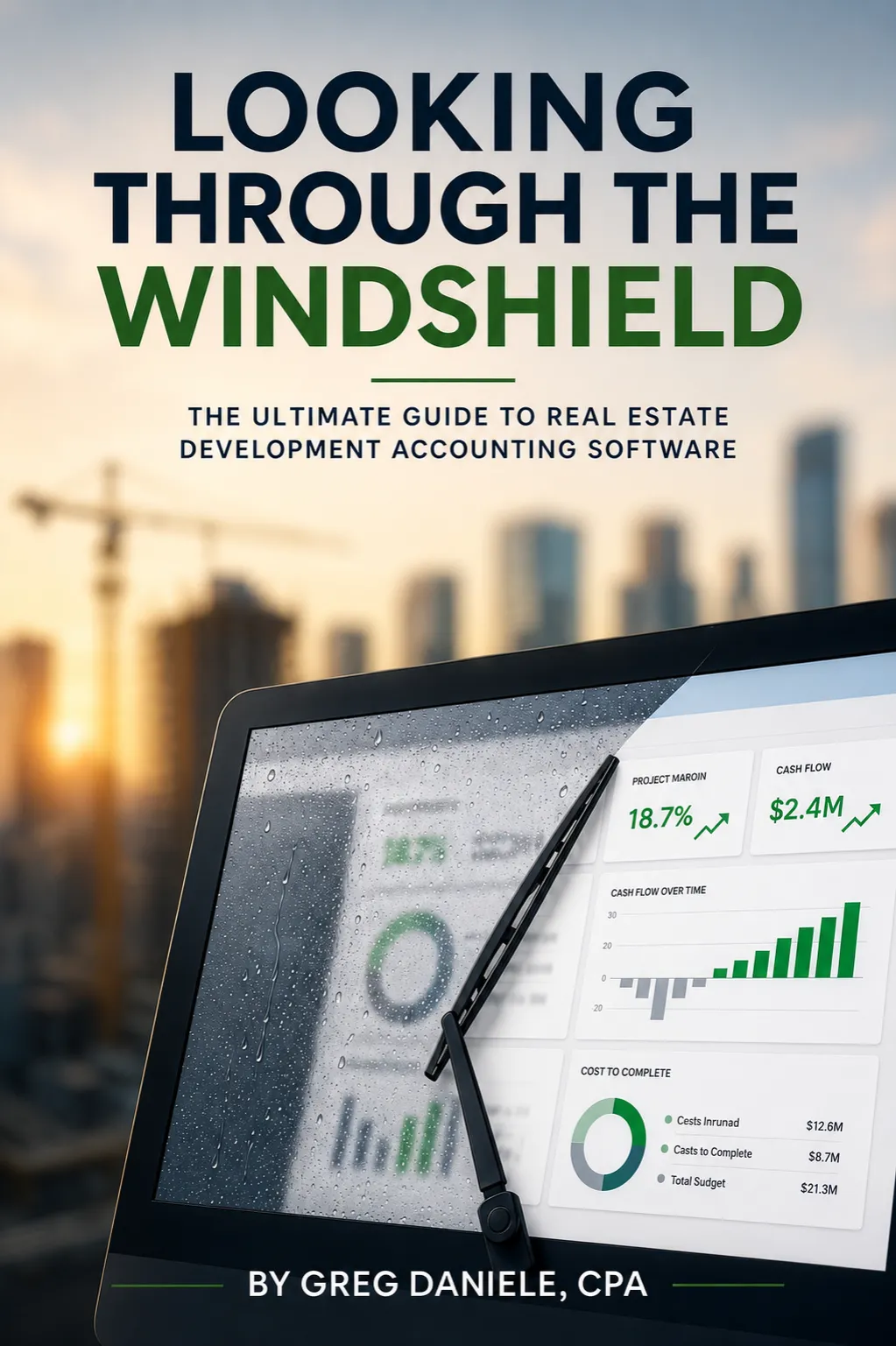
Looking Through the Windshield — the ultimate guide to real estate development accounting software. By Greg Daniele, CPA.

Acumatica gold certified partner
“We have visibility across our entire portfolio now. Draw requests that used to take days are down to almost an hour.”
CFO,
Real Estate Development Firm
“We used to hunt for answers. Now they’re just there. Real-time lot tracking and cost control mean we see issues coming before they become problems.”
VP of Finance,
Land Development Company
“We consolidated three systems into one and cut our month-end close time in half. Everything’s in one place: property management, CAM recovery and tenant improvements. It’s been a game changer for our operations.”
Controller,
Property Management Company
real estate firms
Acumatica-native
typical implementation
users — no per-seat fees
Everything you need to track costs, bill accurately, and close faster.
Stop reconciling job costs from three spreadsheets that never quite agree. Track labor, materials, subcontractor invoices, and overhead automatically at the cost-code level, by project and by phase, so a change in one phase doesn’t get lost in a portfolio-wide total.
Customizable dashboards show budget versus actual at any level, from a single cost code to the full portfolio, with automated variance alerts flagging overruns before they compound.
Your controller sees the same numbers your project managers see, in real time, instead of reconciling two versions of the truth every month-end.
Generate AIA-format progress billing and lender-ready draw schedules in minutes, not days. Automated cost pulling, organized documentation, and lender-specific formatting require little to no manual assembly.
Assembling a draw package by hand takes six to eight hours every month: pulling invoices, mapping costs to lender categories, and hoping nothing was missed. One error and the lender rejects the entire package, delaying payment to your vendors.
With Acumatica, lender category mapping is configured once and applied to every draw. Late invoices recalculate the full package without starting over, and partially funded invoices carry forward automatically. AIA billing forms (G702, G703) generate directly from the same job cost data, so progress billing and draw requests never require reformatting numbers twice.
Dual tracking of your cost and loan budgets means you always know what the lender is funding and what you’re carrying as equity.
Manage multiple entities and partnerships with automated consolidation and intercompany transactions.
See your complete financial picture instantly, no more days consolidating at month-end.
Generate real-time reports and dashboards at the project, entity, or portfolio level.
Know where you stand financially at any moment and spot problems before they impact close.
Migrate historical job cost data, chart of accounts, and open projects from your current system.
Move onto one platform without losing historical project data or starting your job cost history over.
Store contracts, lien waivers, and supporting billing documentation in a searchable repository linked to each project.
Answer an auditor’s question in minutes instead of digging through files across multiple systems. Find what you need in seconds. One source of truth for your entire team.
Track budgets, commitments, and change orders in real time with automated over-budget alerts across every project.
Prevent cost overruns before they happen, and know exactly what’s committed and what’s remaining, project by project.
Track acquisition and pre-development costs from initial prospect through entitlements, before a project breaks ground.
Capture every pre-development dollar so job costs and revenue recognition are accurate from day one.
Schedule a discovery call with our real estate experts. Share your growth goals, current challenges, and operational pain points. Whether it's development cost tracking, contract management, loan draw preparation, or portfolio expansion, we'll map your needs to the right solutions.
Experience a personalized demo of the features that matter to you. Watch real-time budget control, automated draw packaging, and cost-at-completion forecasting in action. See exactly how you'll save time, eliminate errors, increase accuracy, and gain complete visibility.
Our implementation team handles all aspects of your go-live: data migration, system configuration, integrations, workflow setup, and hands-on training. Dedicated real estate professionals support you at every step. Start seeing benefits immediately: reduced risk, accurate reporting, and total control.
Everything you need to know about our real estate development software
Accounting software for real estate developers handles job costing by project and phase, AIA billing, WIP reporting, and percentage-of-completion revenue recognition, requirements general accounting software wasn’t built to handle. A standard general ledger tracks what was spent; it has no concept of a cost code, a draw schedule, or a billed-versus-earned position on an active project. Purpose-built accounting software connects the general ledger to the project itself.
Every cost, labor, materials, subcontractor invoices, and overhead, gets tagged to a specific cost code within a specific project and phase as it’s incurred, rather than reconciled after the fact from separate records. That means budget-versus-actual reporting reflects the real state of the project at any moment, not a snapshot pulled together at month-end.
AIA billing refers to standard construction billing forms, primarily G702 and G703, used to generate progress invoices based on percentage of completion. The platform generates these directly from live job cost data, so progress billing doesn’t require manually reformatting numbers from a separate cost report every billing cycle.
Work-in-progress reporting compares billed-to-date against cost-to-date and percentage of completion for every active project, surfacing over- or under-billing positions as they happen instead of at year-end audit. For developers running multiple active projects, WIP reporting rolls up automatically to the portfolio level, so a controller can see which projects are ahead of or behind their billing position without building that report by hand.
Percentage-of-completion revenue recognition ties revenue recognized on a project to the actual progress of the work, rather than to cash received or invoices sent. The platform calculates this automatically from live job cost data, so recognized revenue reflects real project progress instead of a manual estimate updated once a quarter, which is where most WIP reporting errors originate.
Multi-entity structures are handled natively, with automated consolidation and intercompany transactions across entities, rather than a separate spreadsheet system maintained per entity. You see the complete portfolio financial picture instantly instead of spending days consolidating at month-end.
Implementation typically runs one to three months depending on portfolio complexity, considerably faster than the six-to-twelve-month timelines associated with legacy ERP rollouts. The team handles migration of historical job cost data and open projects, along with system configuration and training, so your team is closing books on the new platform within weeks.
The platform holds SOC 2 Type II certification, with data encrypted in transit and at rest, multi-factor authentication, and role-based access controls. Project financials and billing data are sensitive by nature, and the same security standards apply across every project and entity in the system.
Yes. Implementation includes migration of historical job cost data, chart of accounts, and open projects from your current system, whether that’s spreadsheets, a general accounting package, or another platform, so you don’t lose job cost history or restart projects mid-stream.
Smaller developers often carry the same job costing and revenue recognition complexity as large firms, multiple active projects, AIA billing, WIP reporting, with less staff capacity to manage it by hand. Pricing isn’t tied to user count, which keeps the platform’s cost predictable as project volume grows rather than penalizing growth with per-seat fees.
Book a discovery call in under 60 seconds. We’ll show you what it looks like to run your development and portfolio operations through the windshield, not the rearview mirror.
We use cookies to improve your experience on our site. By using our site, you consent to cookies.
Manage your cookie preferences below:
Essential cookies enable basic functions and are necessary for the proper function of the website.
These cookies are needed for adding comments on this website.
Google reCAPTCHA helps protect websites from spam and abuse by verifying user interactions through challenges.
Google Tag Manager simplifies the management of marketing tags on your website without code changes.
Statistics cookies collect information anonymously. This information helps us understand how visitors use our website.
Google Analytics is a powerful tool that tracks and analyzes website traffic for informed marketing decisions.
Service URL: policies.google.com (opens in a new window)
You can find more information in our Cookie Policy and .

Imagine a single commercial property management software platform to develop and manage the end-to-end daily operations of all your real estate assets.