
Home builder accounting software tracks every lot from land acquisition through construction and closing: job costing to your standard cost codes, budget versus actual by lot, phase and community, and buyer deposits through closing. Elevate serves production builders, custom builders and community developers on one Acumatica-native accounting system.
Real estate development accounting software built on Acumatica and used by developers, controllers and project managers across the US.
New Book
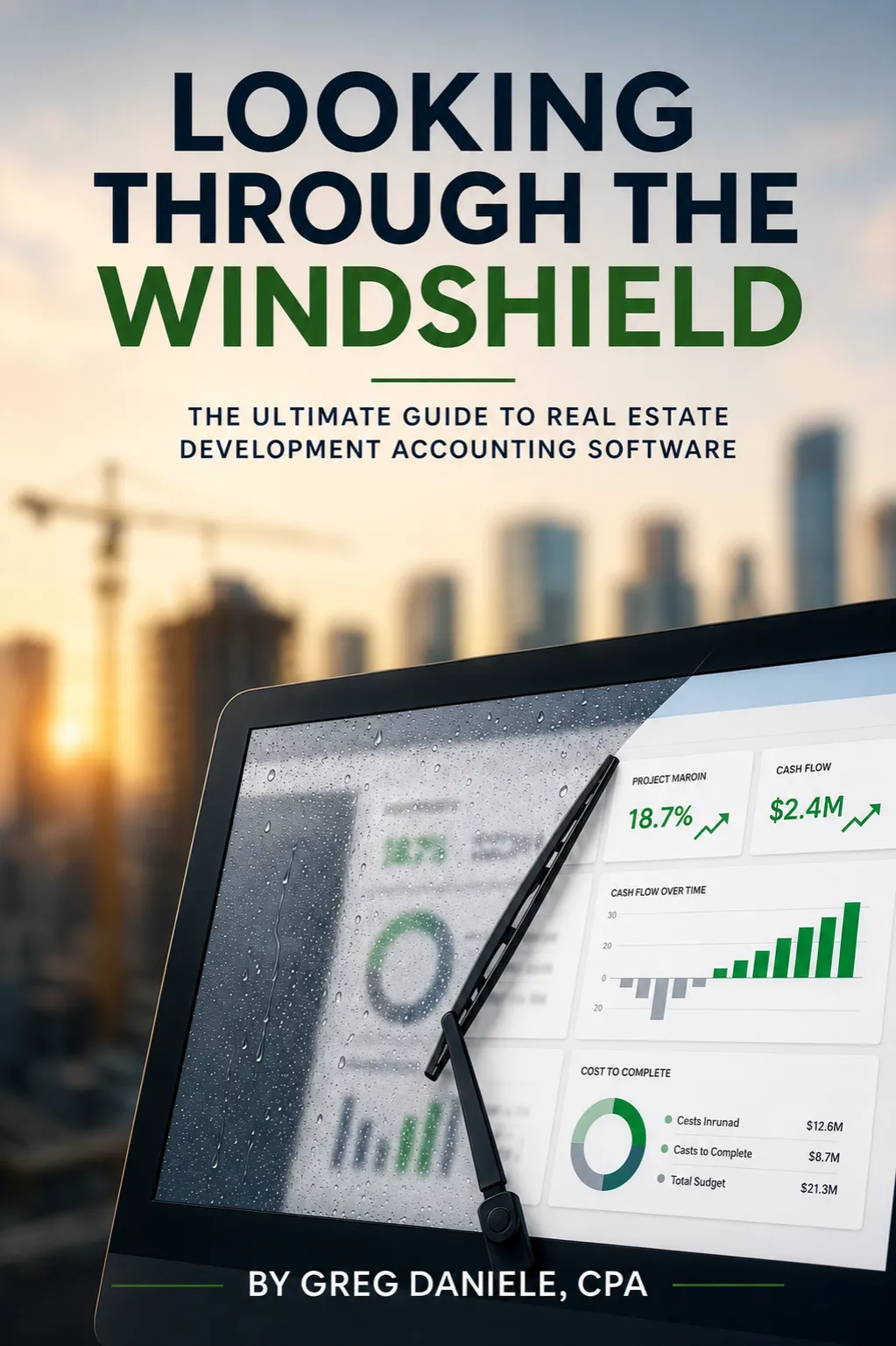
Looking Through the Windshield — the ultimate guide to real estate development accounting software. By Greg Daniele, CPA.

Acumatica gold certified partner
“We have visibility across our entire portfolio now. Draw requests that used to take days are down to almost an hour.”
CFO,
Real Estate Development Firm
“We used to hunt for answers. Now they’re just there. Real-time lot tracking and cost control mean we see issues coming before they become problems.”
VP of Finance,
Land Development Company
“We consolidated three systems into one and cut our month-end close time in half. Everything’s in one place: property management, CAM recovery and tenant improvements. It’s been a game changer for our operations.”
Controller,
Property Management Company
typical implementation
users — no per-seat fees
A home builder’s question is rarely what the company spent on lumber this month. It is what lot 14 has cost so far, and how phase two compares with its budget. General accounting software has no clean answer to that without a spreadsheet sitting beside it.
On Elevate’s platform, costs are coded by project, phase and cost code as they are entered. During setup we map your communities, phases and lots onto that structure, so land, horizontal development and vertical construction costs each land where they belong. Budgets, commitments and change orders sit next to actual costs at every level, and automated over-budget alerts flag a problem while the home is still under construction.
Land and pre-development costs are captured from the first acquisition dollar through entitlements, so each community’s cost basis is complete from day one rather than estimated when the first home closes.
Builders who finance communities with construction loans spend real time assembling draw requests: cost reports, invoices, lien waivers and a reconciliation that proves the request matches the books. When the package is built by hand, each draw takes days and every lender wants it in a slightly different format.
The platform builds draw packages from the same job cost data that runs your financial statements. Invoices and lien waivers are attached to the costs they support, budgets and commitments show what remains to fund, and lender-specific formats come from one set of numbers. AIA-format billing is available where a lender or owner requires it.
Because draws come from the ledger, the amount requested, the amount funded and the loan balance on your balance sheet stay in agreement. When a lender’s inspector or auditor asks a question, the backup is already linked to the transaction.
Many developers who build homes set up a separate LLC for each community, plus a land entity, a management company and sometimes a fund above them. In QuickBooks that means one company file per entity and a consolidation spreadsheet at every month-end.
Elevate runs every entity in one Acumatica system, with automated consolidation and intercompany transactions. A management fee charged to a community, or a land transfer from a holding entity, posts on both sides at once. You can report on a single community, a group of communities or the whole company without exporting anything.
Users are unlimited with no per-seat fees, so purchasing, field and accounting staff can all work in the same system as you add communities. Partners and lenders get reports at the entity level they ask for, drawn from books that already reconcile.
Journal entries post automatically, from the first buyer deposit through progress billings to final closing.
Each closing updates revenue, cost of sales and deposit balances together, so community margins are current every month.
Sales, options, scheduling and warranty are handled in the home builder software that Acumatica integrates with.
Builders keep the field and sales tools they already use, and Acumatica handles the accounting.
Track budgets, signed subcontracts and change orders by community, phase and cost code, with over-budget alerts as costs post.
Know what each home is committed to cost before the invoices arrive, and catch overruns while they can still be fixed.
Track lien waivers and vendor compliance documents against each trade partner and payment across all of your communities.
Spot a missing waiver or an expired insurance certificate before payment, not when the lender asks for it at draw time.
Elevate migrates your chart of accounts, job cost history and open communities from QuickBooks, Sage or spreadsheets into Acumatica.
Move off one-file-per-entity accounting without starting your cost history over or losing the detail behind open lots.
Acumatica licenses by the resources you use, and Elevate’s platform includes unlimited users with no per-seat fees.
Give purchasing, field and sales staff access as you add communities, without the license bill growing with every new hire.
Schedule a discovery call with our real estate experts. Share your growth goals, current challenges, and operational pain points. Whether it's development cost tracking, contract management, loan draw preparation, or portfolio expansion, we'll map your needs to the right solutions.
Experience a personalized demo of the features that matter to you. Watch real-time budget control, automated draw packaging, and cost-at-completion forecasting in action. See exactly how you'll save time, eliminate errors, increase accuracy, and gain complete visibility.
Our implementation team handles all aspects of your go-live: data migration, system configuration, integrations, workflow setup, and hands-on training. Dedicated real estate professionals support you at every step. Start seeing benefits immediately: reduced risk, accurate reporting, and total control.
Smaller home builders often start on QuickBooks or Sage with job costing kept in spreadsheets, while larger builders move to construction ERP systems that handle job costing, draws and multiple entities natively. The right choice depends on your structure more than your size. If you run several communities in separate LLCs, finance them with construction loans and need cost reports by lot and phase, you need a system built for project accounting. Elevate provides home builder accounting software on Acumatica cloud ERP for real estate developers who build homes, with job costing, draw packages and multi-entity consolidation in one database.
Home builders track job costs by giving every cost a project, phase and cost code when it is entered, then reporting against a budget at the same level. Typically the community is the project, phases represent development stages or groups of homes, and cost codes cover land, site work and each construction category, with lot detail carried in that structure so you can see the cost of an individual home. On Elevate’s platform the exact structure is agreed during implementation, and subcontract commitments and change orders are tracked at the same level, so cost to complete is visible for each lot and phase. For custom builders, each home is its own project. For community builders, each home is a task within a phase.
Acumatica covers the core accounting needs of home builders and integrates with leading home builder software for the rest. Construction loan draw packages come straight from job cost data. For buyer deposits and closings, journal entries post automatically, from the first deposit through progress billings to final closing. Sales, options and warranty are handled in the home builder software that Acumatica integrates with, which is used by both production and custom builders.
Home builders usually outgrow QuickBooks when the number of communities and entities grows faster than the accounting team. Each LLC needs its own company file, consolidation happens in a spreadsheet, and job costing by lot and phase depends on exports and manual coding. Draw requests take longer because cost reports are rebuilt for each lender, and user limits restrict who can see the numbers. Moving to an Acumatica-based system keeps every entity in one database, produces job cost and draw reports from the ledger, and removes per-seat fees. Elevate migrates your QuickBooks history so open communities keep their cost detail.
Home builder accounting software is a type of construction accounting software with a different emphasis. Commercial contractors focus on billing an owner through AIA applications, retainage and WIP schedules. Builders who own the land and sell the homes focus on lot and community costing, land basis, construction loan draws, buyer deposits and closings. Many developers do both, building some projects for sale and others to hold. Elevate’s platform covers job costing, AIA billing, WIP and draws in one system, so the same books work whether a community is built for sale or a project is built to hold and lease.
Elevate Solutions serves production builders, custom builders, community developers and land developers that sell lots to builders. Acumatica supports home builders in two ways. It handles land development well, covering lot inventory, takedown schedules, builder agreements, lot-level cost tracking, and buyer deposits through closing, all tied directly to development accounting. And it integrates with home builder software that handles sales, options, scheduling and warranty for production and custom builders, so builders keep the field and sales tools they already use and Acumatica handles the accounting.
Yes. Implementation includes migration of your chart of accounts, historical job cost data and open projects from QuickBooks, Sage, spreadsheets or another system. For a builder, that means open communities move across with their budgets, commitments and costs to date, so you do not restart cost history in the middle of a build. How much closed history to bring over is decided together during discovery, based on what your lenders, partners and auditors need to see. Implementation also covers system configuration, workflow setup and hands-on training, so your team is working in the new system with its own projects before go-live.
Book a discovery call in under 60 seconds. We’ll show you what it looks like to run your development and portfolio operations through the windshield, not the rearview mirror.
We use cookies to improve your experience on our site. By using our site, you consent to cookies.
Manage your cookie preferences below:
Essential cookies enable basic functions and are necessary for the proper function of the website.
These cookies are needed for adding comments on this website.
Google reCAPTCHA helps protect websites from spam and abuse by verifying user interactions through challenges.
Google Tag Manager simplifies the management of marketing tags on your website without code changes.
Statistics cookies collect information anonymously. This information helps us understand how visitors use our website.
Google Analytics is a powerful tool that tracks and analyzes website traffic for informed marketing decisions.
Service URL: policies.google.com (opens in a new window)
You can find more information in our Cookie Policy and .

Imagine a single commercial property management software platform to develop and manage the end-to-end daily operations of all your real estate assets.