
Real estate fund accounting software records capital calls, contributions, distributions and investor capital accounts at the fund level while keeping property-level books for every asset the fund owns. Elevate runs both on Acumatica cloud ERP with multi-entity accounting, automated consolidation and intercompany, so fund reporting draws from the same ledger as your properties.
Real estate development accounting software built on Acumatica and used by developers, controllers and project managers across the US.
New Book
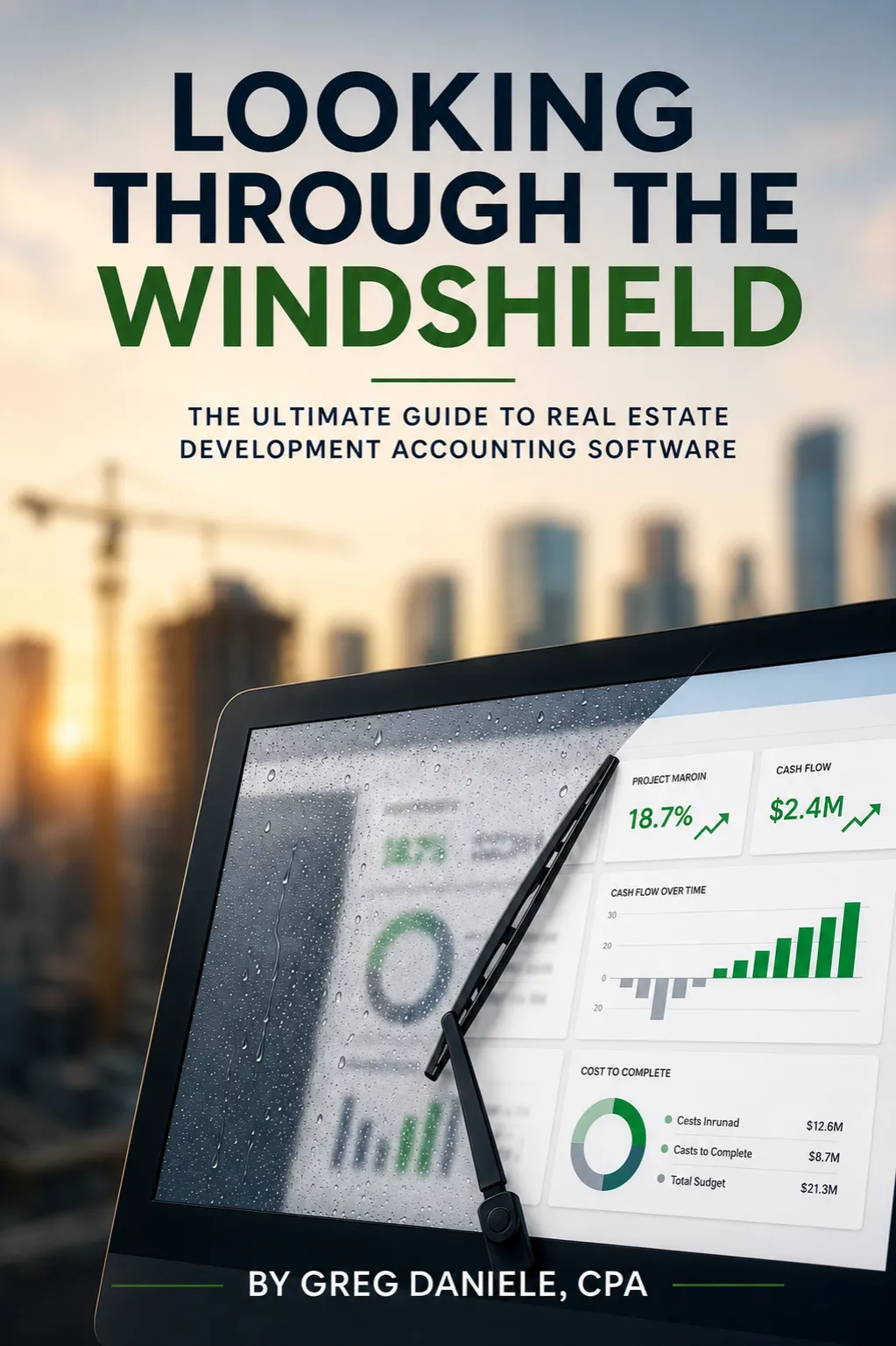
Looking Through the Windshield — the ultimate guide to real estate development accounting software. By Greg Daniele, CPA.

Acumatica gold certified partner
“We have visibility across our entire portfolio now. Draw requests that used to take days are down to almost an hour.”
CFO,
Real Estate Development Firm
“We used to hunt for answers. Now they’re just there. Real-time lot tracking and cost control mean we see issues coming before they become problems.”
VP of Finance,
Land Development Company
“We consolidated three systems into one and cut our month-end close time in half. Everything’s in one place: property management, CAM recovery and tenant improvements. It’s been a game changer for our operations.”
Controller,
Property Management Company
typical implementation
users — no per-seat fees
A real estate fund is rarely one entity. A typical structure includes the fund itself, a general partner, a management company, and a separate LLC or joint venture for each property, each with its own books, bank accounts and investors or lenders. Fund accounting has to respect every one of those boundaries and still produce a single picture of the portfolio.
Elevate handles multi-entity structures natively on Acumatica. Each entity keeps its own general ledger, intercompany transactions such as management fees, advances and shared expenses are recorded on both sides, and consolidation is automated rather than rebuilt in a spreadsheet every quarter.
Because property books live in the same system, the numbers that reach the fund level come from the same ledger that paid the property’s invoices and recorded its rent. When an investor asks about one asset, you can trace the figure down to the transactions behind it.
Capital moves through a fund in a predictable cycle. Investors commit capital at closing, the general partner calls a portion of that commitment when a deal or expense needs funding, contributions arrive and are credited to each partner’s capital account, and distributions flow back out as properties generate cash or sell. Every step changes unfunded commitments and capital balances, and every step has to be documented.
In the books, a capital call usually records an amount due from each investor against their capital account, the contribution clears it, and a distribution reduces capital or allocates income according to the partnership agreement. Keeping these entries in the same multi-entity ledger as the property books means capital activity and operating results reconcile without a separate tracking workbook.
How calls, contributions and distributions are recorded and allocated in your environment is set during implementation, based on your partnership agreements and the reports your investors expect.
Set each partner’s ownership percentage once per entity, and every consolidation and investor report applies it automatically. Investors see their share of project cost, contributions and distributions from live data, not a spreadsheet rebuilt every quarter.
Reports can consolidate selected entities, such as one investor group’s portfolio or a single fund, so each investor sees exactly the part of the portfolio they own. Contribution and distribution detail and property performance all come from the same ledger as the property books, so the figures investors see tie back to recorded transactions.
Consolidate fund, general partner, joint venture and property entities automatically instead of rebuilding the roll-up in a spreadsheet.
Give investors fund-level results each quarter without days of manual consolidation work before every report.
Record management fees, advances and shared costs between entities with both sides of each intercompany entry posted.
Due-to and due-from balances stay in agreement, so intercompany reconciliation stops being a month-end project.
Generate reports and dashboards at the property, entity, fund or portfolio level from one set of books.
Asset managers and fund controllers read the same numbers, so performance questions get answered from one source.
Funds that develop can run job costing by project, phase and cost code, loan draw packages and change orders in the same system.
Ground-up and value-add projects report into the fund without a separate construction accounting system to reconcile.
Elevate offers unlimited users with no per-seat fees, on Acumatica’s resource-based licensing rather than per-user pricing.
Give fund accounting, asset management and investor relations staff access without rationing logins or sharing accounts.
Historical data, chart of accounts and open balances can be migrated from spreadsheets, QuickBooks, Sage or Yardi during implementation.
Start on the new platform with capital balances and property history intact instead of rebuilding them by hand.
Schedule a discovery call with our real estate experts. Share your growth goals, current challenges, and operational pain points. Whether it's development cost tracking, contract management, loan draw preparation, or portfolio expansion, we'll map your needs to the right solutions.
Experience a personalized demo of the features that matter to you. Watch real-time budget control, automated draw packaging, and cost-at-completion forecasting in action. See exactly how you'll save time, eliminate errors, increase accuracy, and gain complete visibility.
Our implementation team handles all aspects of your go-live: data migration, system configuration, integrations, workflow setup, and hands-on training. Dedicated real estate professionals support you at every step. Start seeing benefits immediately: reduced risk, accurate reporting, and total control.
Real estate fund accounting software keeps the books for an investment vehicle that owns real estate, tracking investor commitments, capital calls, contributions, distributions and capital accounts at the fund level. Because a fund usually owns its assets through separate entities, the software also has to handle property-level books, intercompany activity and consolidation. Elevate runs fund and property accounting together on Acumatica cloud ERP, with multi-entity accounting, automated consolidation and investor reporting from one ledger. Our real estate investment management software page covers the wider investment workflow.
Capital calls are recorded as amounts due from each investor against their capital account, and the contribution clears that receivable when the cash arrives. The call also reduces each investor’s unfunded commitment, which is tracked and reported to investors even though it is not a balance sheet item. Distributions are recorded as returns of capital or allocations of income, depending on their source and the partnership agreement, and are split among investors by ownership percentage. In Elevate, these entries live in the same multi-entity ledger as the property books, and allocation rules are configured from your agreements during implementation.
Yes. Acumatica handles multi-entity accounting natively, so the fund, its general partner, joint ventures and each property entity keep their own general ledgers inside one system. Intercompany transactions such as management fees and advances are recorded on both sides, and consolidation is automated. Property teams record rent, tenant charges and operating expenses at the property level, and the fund sees those results without an export. That also means a question about a fund-level number can be traced back to the property transaction behind it, which shortens audit requests and investor follow-ups.
Property accounting records what happens inside a building, while fund accounting records what happens between the fund and its investors. Property books cover rent and tenant charges, operating expenses, CAM recoveries, debt service and capital improvements. Fund books cover commitments, capital calls, contributions, distributions, fees, capital account balances and returns. The two meet at consolidation, where property results roll into the fund and become the basis for investor reporting. Running them in separate systems means reconciling every quarter. Elevate keeps both on one Acumatica ledger, with commercial real estate accounting at the property level.
Elevate produces investor reporting from the same ledger that holds your fund and property books, so statements and performance figures tie back to recorded transactions. Investor reporting typically covers capital account statements, distribution detail, and property and fund performance, prepared on the schedule your agreements require. We can show sample reporting during a personalized demo.
Yes. Implementation includes data migration from spreadsheets, QuickBooks, Sage or Yardi, covering the chart of accounts, historical data and open balances for each entity. For fund accounting, the priority is usually investor capital balances, commitment and contribution history, and the property-level history you report on. How far back to migrate, and at what level of detail, is agreed during scoping.
Anyone who needs to. Elevate offers unlimited users with no per-seat fees, and Acumatica is licensed by the resources a company uses rather than by headcount. In a real estate fund that means fund accountants, property accountants, asset managers, investor relations and the CFO can all work in the same system with role-based access, instead of exporting reports for colleagues who do not have a login. Pricing for your structure is covered on a discovery call.
Book a discovery call in under 60 seconds. We’ll show you what it looks like to run your development and portfolio operations through the windshield, not the rearview mirror.
We use cookies to improve your experience on our site. By using our site, you consent to cookies.
Manage your cookie preferences below:
Essential cookies enable basic functions and are necessary for the proper function of the website.
These cookies are needed for adding comments on this website.
Google reCAPTCHA helps protect websites from spam and abuse by verifying user interactions through challenges.
Google Tag Manager simplifies the management of marketing tags on your website without code changes.
Statistics cookies collect information anonymously. This information helps us understand how visitors use our website.
Google Analytics is a powerful tool that tracks and analyzes website traffic for informed marketing decisions.
Service URL: policies.google.com (opens in a new window)
You can find more information in our Cookie Policy and .

Imagine a single commercial property management software platform to develop and manage the end-to-end daily operations of all your real estate assets.