
A Yardi alternative, including a Yardi Voyager alternative, is worth considering when your firm develops and operates commercial property and needs development accounting, construction and commercial property management on one ledger. Elevate runs all three on Acumatica, sharing one database and one set of books.
Built on Acumatica and used by owners, operators and controllers across the US.
New Book
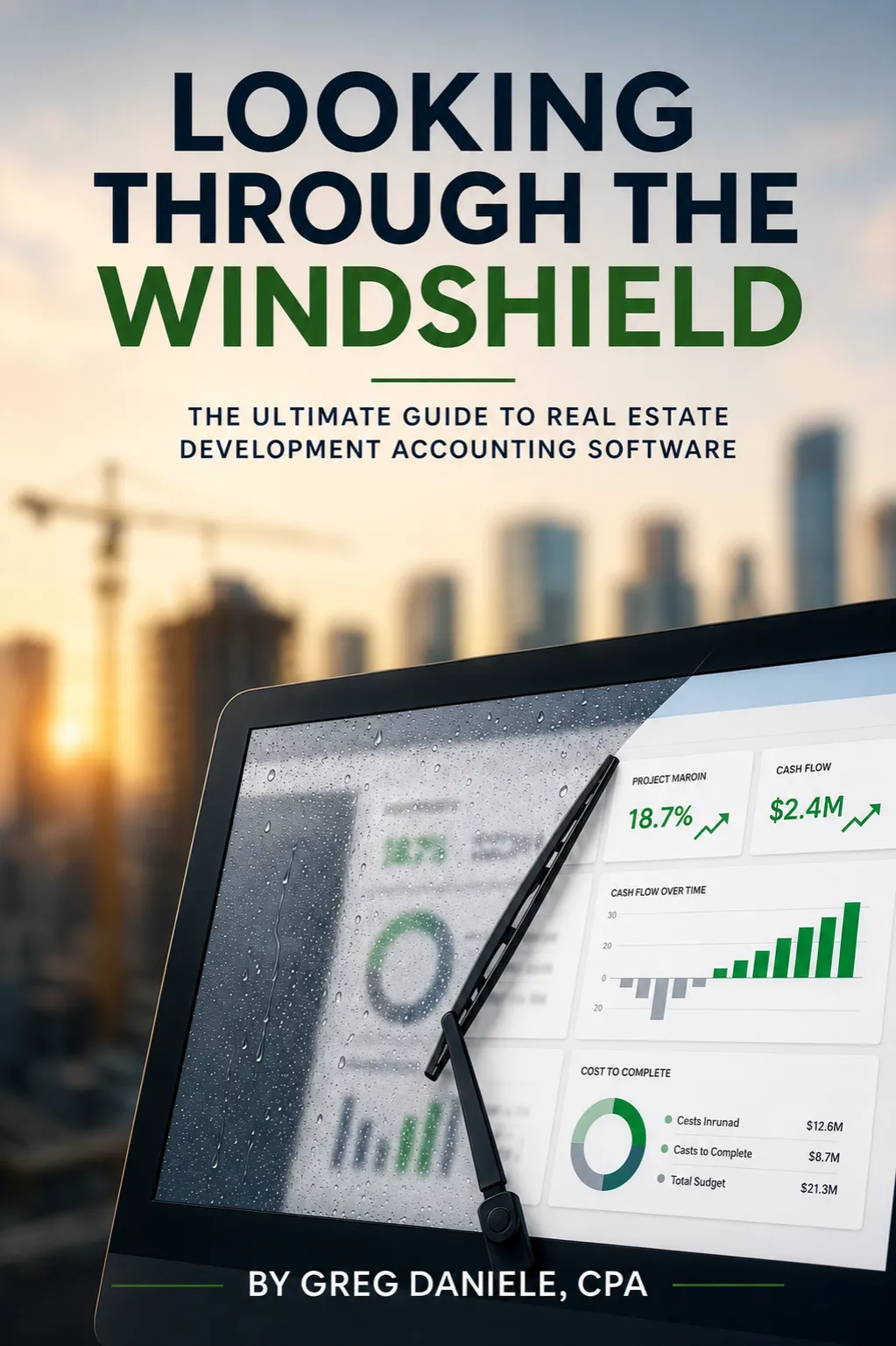
Looking Through the Windshield — the ultimate guide to real estate development accounting software. By Greg Daniele, CPA.

Acumatica gold certified partner
“We have visibility across our entire portfolio now. Draw requests that used to take days are down to almost an hour.”
CFO,
Real Estate Development Firm
“We used to hunt for answers. Now they’re just there. Real-time lot tracking and cost control mean we see issues coming before they become problems.”
VP of Finance,
Land Development Company
“We consolidated three systems into one and cut our month-end close time in half. Everything’s in one place: property management, CAM recovery and tenant improvements. It’s been a game changer for our operations.”
Controller,
Property Management Company
typical implementation
users — no per-seat fees
Yardi is one of the most established names in real estate software, and its products are built around property management. Yardi Breeze is its cloud platform aimed at small and midsize portfolios, covering leasing, tenant management and property accounting. Yardi Voyager is its enterprise platform for larger operators, with a wider set of modules for portfolios that need more configuration.
If your firm’s work is mainly operating stabilized properties, your teams are trained on Yardi, and your accounting needs fit inside a property management system, staying on Yardi can be a sound decision. Switching platforms carries real cost and disruption, so it should solve a specific problem you can name.
Elevate also delivers commercial property management, including leases, CAM and tenant ledgers, so if property operations are your main concern we can compare that side directly against how you work in Yardi today.
The case for a Yardi alternative is strongest when property management is only part of what your firm does. Developers, builders and investment firms that also operate property need development and construction accounting, multi-entity consolidation and investor reporting, and they need it on the same ledger as their leases.
Elevate is built on Acumatica cloud ERP and configured for real estate. That covers job costing by project, phase and cost code, budgets, commitments and change orders, AIA billing, WIP and percentage-of-completion revenue recognition, loan draw packages, lien waiver and vendor compliance tracking, and commercial property management with leases, CAM and tenant ledgers. Multi-entity accounting with automated consolidation and intercompany is part of the core.
Acumatica is licensed by resources rather than seats, and Elevate offers unlimited users with no per-seat fees, which matters when project, property and finance staff all need access to the same records.
Moving from Yardi? Acumatica migrates your chart of accounts, vendors, tenants and leases, open AP and AR, and general ledger history, and maps your old accounts to Acumatica’s standard real estate chart of accounts and cost codes.
From there the steps are familiar to any controller. The old chart of accounts is mapped to the new one, opening balances and history are loaded, and a parallel close is a common way to prove the numbers agree before cutover at a period end. Your team checks the results against Yardi reports before anything is switched off.
Some firms prefer to keep Yardi for property operations and run accounting, development and construction in Acumatica. If that is your situation, we scope how data would move between the two on a discovery call before you commit to either path.
Elevate runs on Acumatica, a general-purpose cloud ERP configured for real estate rather than a property management system.
Check whether your finance work fits a property management core or needs a full ERP general ledger underneath it.
Job costing by project, phase and cost code, AIA billing, WIP and percentage-of-completion revenue recognition on one ledger.
Firms that build as well as operate can account for construction and operations without a second system.
Native multi-entity accounting with automated consolidation and intercompany transactions across properties, funds and development entities.
Owners with many LLCs and partnerships can close and consolidate without exporting every entity to spreadsheets.
Leases, CAM and tenant ledgers run on the same Acumatica platform as your accounting and investor reporting.
Compare this directly with your current Yardi property workflows to see what would change for your property teams.
Acumatica uses resource-based licensing, and Elevate offers unlimited users with no per-seat fees for your whole team.
Adding staff, partners or outside accountants does not add per-seat charges as your firm and portfolio grow.
Implementation includes migrating the chart of accounts, historical data and open balances from Yardi, spreadsheets, QuickBooks or Sage.
You choose how much history to bring over, and your team verifies balances before the old system is retired.
Schedule a discovery call with our real estate experts. Share your growth goals, current challenges, and operational pain points. Whether it's development cost tracking, contract management, loan draw preparation, or portfolio expansion, we'll map your needs to the right solutions.
Experience a personalized demo of the features that matter to you. Watch real-time budget control, automated draw packaging, and cost-at-completion forecasting in action. See exactly how you'll save time, eliminate errors, increase accuracy, and gain complete visibility.
Our implementation team handles all aspects of your go-live: data migration, system configuration, integrations, workflow setup, and hands-on training. Dedicated real estate professionals support you at every step. Start seeing benefits immediately: reduced risk, accurate reporting, and total control.
The best Yardi alternative depends on what your firm does beyond property management. If you mainly operate stabilized properties, another property management system may be the closer match. If you also develop, build or manage investment funds, an ERP-based option such as Elevate on Acumatica covers development and construction accounting, multi-entity consolidation, commercial property management and investor reporting on one ledger. Start by listing the work your current system pushes into spreadsheets, then compare platforms against that list rather than against a generic feature grid.
Acumatica is the right fit for developers who build any asset type and for owners who operate commercial portfolios. If you mainly run residential or multifamily leasing, a residential property management system is a better fit.
Migrating off Yardi is manageable when the scope is agreed up front, and the effort depends mostly on the number of entities, the amount of history you keep and how many open leases and balances need to move. Migration covers your chart of accounts, vendors, tenants and leases, open AP and AR, and general ledger history. A parallel close before cutover is the usual way to prove the new system matches the old one. We size the work for your portfolio on a discovery call rather than quoting a generic timeline.
Elevate can be a Yardi Breeze alternative when a smaller firm’s needs go beyond property management. Breeze is aimed at small and midsize portfolios that want property management and accounting in one package. Elevate suits smaller developers, builders and commercial owners who need job costing, draw management, multi-entity books or investor reporting alongside their leases. Smaller firms often carry the same accounting complexity as large ones, with fewer people to handle it. Unlimited users with no per-seat fees also means a growing team does not add seat charges.
Yardi Voyager and Elevate on Acumatica both serve larger real estate organizations, from different starting points. Voyager is Yardi’s enterprise property management and accounting platform, so it starts from property operations. Acumatica is a cloud ERP, so Elevate starts from the general ledger and adds real estate development, construction, commercial property management and investor reporting on top. Firms with active development pipelines or complex entity structures tend to weigh that difference most. We recommend seeing both in a demo with your own scenarios, such as a draw request or a quarterly consolidation. Our Acumatica overview explains the platform itself.
Yes, keeping Yardi for property operations and running accounting, development and construction on a separate ERP is a workable setup. The question is how data moves between the two, whether by summary journal entries, file imports or an integration, and how often. That design affects your close process and audit trail, so it should be agreed before implementation starts. We scope the data flow on a discovery call. If the long-term goal is a single platform, Elevate’s commercial property management can take over leases, CAM and tenant ledgers at a later stage.
Acumatica is licensed based on the resources a company uses rather than the number of named users, and Elevate offers unlimited users with no per-seat fees. In practice that means you can give project managers, property managers, asset managers and outside accountants access without a license count rising with each new login. That makes it easier to give field, property and finance staff direct access instead of routing requests through the accounting team. Pricing for your portfolio is covered on a discovery call.
Book a discovery call in under 60 seconds. We’ll show you what it looks like to run your development and portfolio operations through the windshield, not the rearview mirror.
We use cookies to improve your experience on our site. By using our site, you consent to cookies.
Manage your cookie preferences below:
Essential cookies enable basic functions and are necessary for the proper function of the website.
These cookies are needed for adding comments on this website.
Google reCAPTCHA helps protect websites from spam and abuse by verifying user interactions through challenges.
Google Tag Manager simplifies the management of marketing tags on your website without code changes.
Statistics cookies collect information anonymously. This information helps us understand how visitors use our website.
Google Analytics is a powerful tool that tracks and analyzes website traffic for informed marketing decisions.
Service URL: policies.google.com (opens in a new window)
You can find more information in our Cookie Policy and .

Imagine a single commercial property management software platform to develop and manage the end-to-end daily operations of all your real estate assets.